The Kagura Shrine in Japan and Kagura Dance
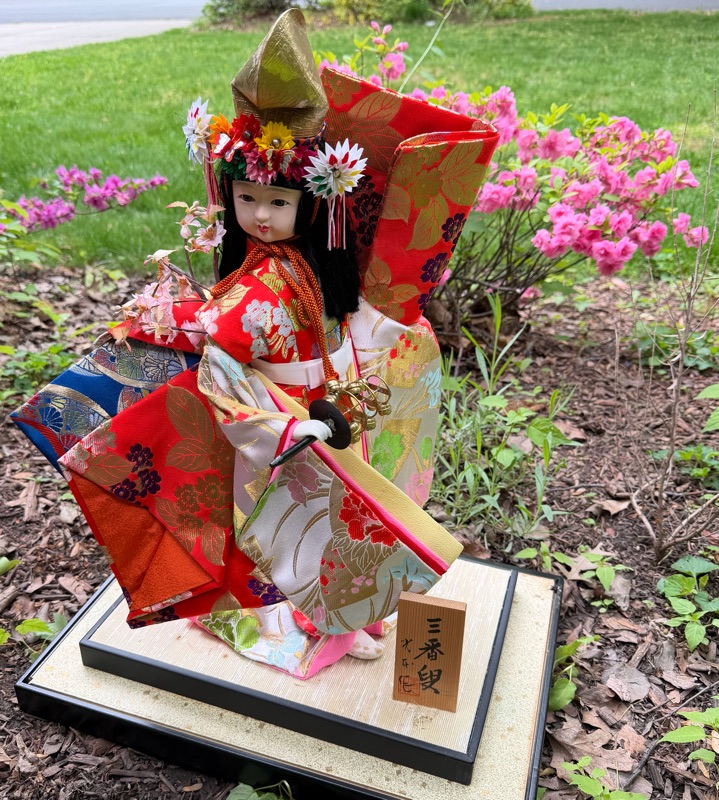
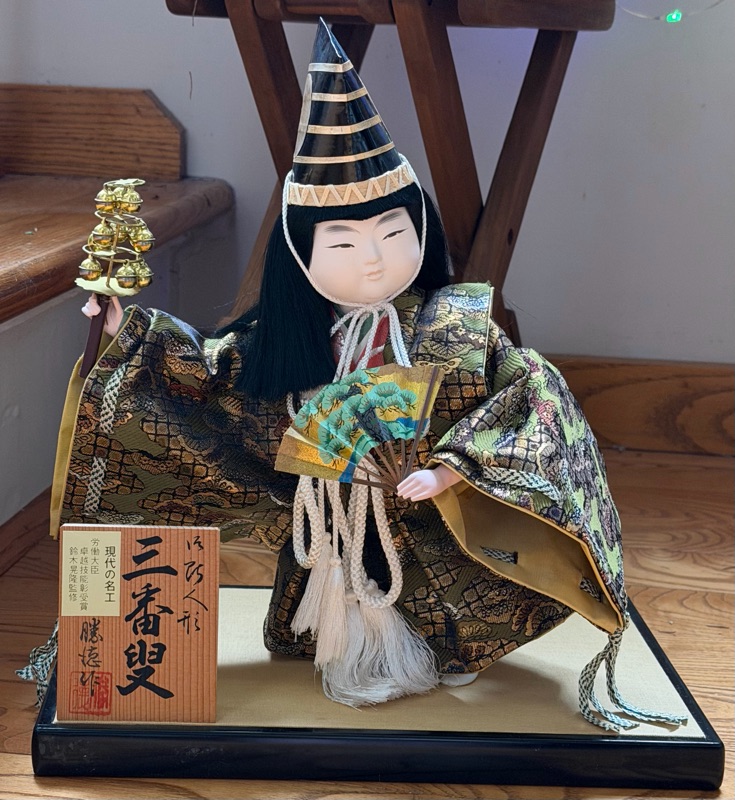
Above, two dolls who are performing sacred dances that use Kagura Suzu bells. From what I understand, Suzu bells feature as accessories that are held by many dolls but they can be either a single round bell or a pair of bells.
The Kagura Suzu bells represent the original Sakaki branch utilised by the goddess who danced to bring the Sun god Amaterasu out of hiding. When she heard the laughter and sound of the dance performance, she looked out from the cave to see what was happening. In some versions of the myth, the goddess performing the dance showed her private parts and this inspired laughter. Sexual gestures in folk performances often are intended to be entertaining and comedic rather than lascivious and the laughter brought Amaterasu out of hiding.
The Sakaki branch still considered sacred became a set of bells in the actual Kagura dance that retold the tale. Bells are used in many cultures to summon the gods or spiritual power. The Kagura Suzu bells are either 12 or 15 bells arranged in three tiers.
It is not very easy to find dolls with the Kagura Suzu bells. Drums and fans are far more common. Moreover, the male Sanbaso dancer is more common than the female.
In Guardians of Azuma, the dance of power is named the ‘Dance of Bonds’. As Earth Dancer, I think if you play as a girl you are in the position of a miko/maiko Shrine maiden. You actually live in the Dragon Shrines and you stand before the individual or statue you wish to bless and execute a brief dance with a Sacred Plum Branch in your hand. Later after you have progressed more towards saving Azuma from a new Celestial Collapse, Iroha gives you a special Fan she has made that incorporates the images and powers of the various elements and this takes the place of the plum branch.
You will be given a number of Sacred Treasures as you restore the powers of the various gods.
First, Ulalaka, the goddess of Spring and Fertility gives you her Sacred Drum. With this, you can restore life to dying trees and animals.
In the Summer village, you are given Matsuri’s Sacred Sword, embodying the power of fire. Matsuri is the goddess of Revelry and Swords. Summer has a volcano that has been inactive for a long time. You restore its vitality. That traditionally is the power of untamed fire.
In Autumn, you restore the power of Kurama, the goddess of Winds who is a Tengu in his non human manifestation. As the winds blow once again across the land, crops and rice paddies flourish once more.
In Winter, you are given a Sacred Parasol. It allows you to travel across any abyss and imbued with the power of water. It actually serves to melt the frozen waterfalls and rivers a little to allow water to flow freely once more for the fish who live in the rivers and lakes and the waterwheels that create power.
When you restore power to the God of the Underworld, you receive his Sacred Mask. In restoring the Goddess of Heaven, you receive her sacred Staff. These two treasures respectively represent Darkness and Light.
I have written another post about the history of the Kagura Suzu Dance itself.
In the surviving Japanese traditions, there are both male and female dancers. In my own view, the significance of the female Sanbaso Miko dancers has become significantly diluted. It has become a commercial performance at many Shrines now, elegant and beautiful, and no doubt there are Shrines Maudens who execute it with real spiritual dedication, but originally it might have been one of the most potent rites in Shinto traditions and it would have been conducted by a woman. Shamanism is at the heart of most very ancient belief systems and Shinto traditions still display some of that foundation.
Kami is power. A female shaman, possibly a virgin who had been dedicated to serve the divine, would use the sacred bells known now as Kagura Suzu bells, to call the divine power unto herself by facilitating a trance state in which she would become the voice of the gods. She then would make prophetic declarations and possibly perform healings. Was she attached to a specific Shrine or would she travel from place to place with a retinue? Both of these traditions still can be found in a modified form in Japan.
https://freyashawkguardiansofazuma.blogspot.com/2026/05/traditional-sacred-symbols-in-japan.html

